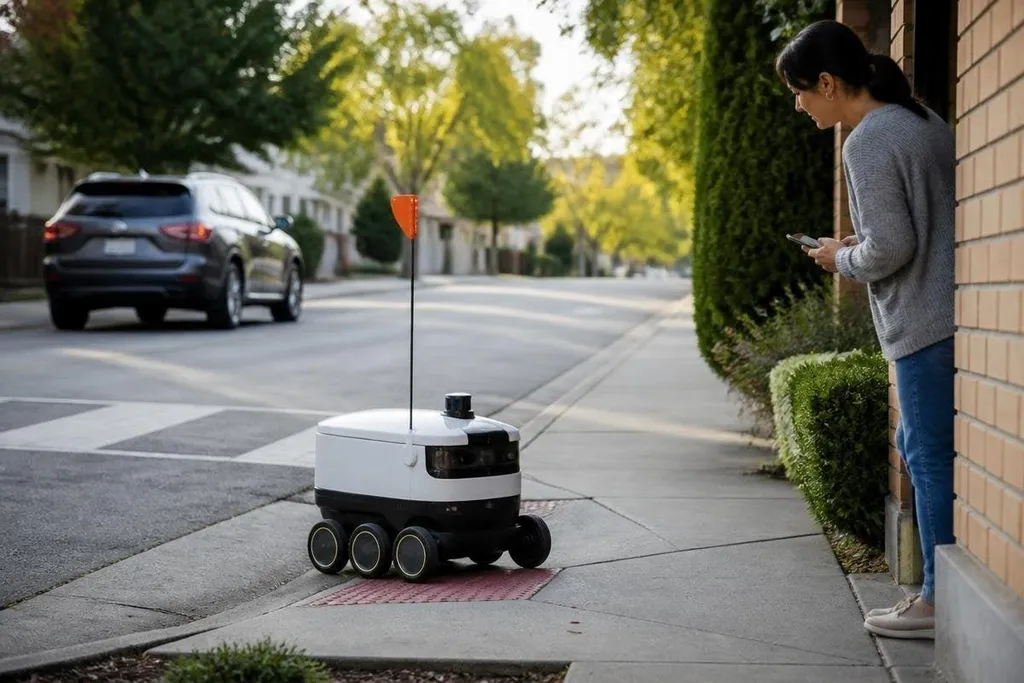
A last-mile robot works close to people, cars, driveways, curbs, and doors. AI helps it read that messy space, choose a route, and ask for help when its sensors cannot settle on a safe move.
For a delivery manager, the useful question is practical: does AI reduce human work without creating new delays or safety risks?
- Cameras and LiDAR help the robot spot people, vehicles, curbs, and other objects.
- Mapping software links sensor data to a route, while geofencing keeps the robot inside approved areas.
- Remote operators still matter when a blocked path or unusual handoff stops the robot.
How the robot reads the street
A last-mile robot combines several sensor types. Cameras record images, LiDAR measures distance with laser pulses, and wheel encoders track how far the drive motors have turned.
Each input covers a different weakness, so the robot can compare what it sees with what its map expects. That process supports simultaneous localization and mapping, or SLAM. The system builds a map while estimating its own position inside it.
A delivery route then becomes more than a line on a screen: the system must account for a curb, a parked car, a person stepping into its path, or a gate that was open earlier.
AI can sort objects in camera images and estimate how they may move. A person walking across a sidewalk needs a different response from a bin that will stay still. The software can slow the robot, stop it, or select another path based on those readings.
The result depends on the training data and the sensor setup. A model that works well on clear sidewalks may need more checks in rain, snow, poor light, or crowded areas.
Route planning changes during a delivery
A fixed route gives the robot a starting plan. AI helps it adjust that plan when the street changes. It can weigh distance, blocked paths, crossing points, battery level, and delivery windows before selecting its next move.
That choice affects the whole delivery run. A robot that reaches a closed sidewalk may need to turn around, wait, or send a request to a remote operator. The operator can review the robot's camera view and guide it through a case the onboard software cannot handle.
This human-in-the-loop setup also changes staffing. People may supervise several robots, but the exact number depends on the streets, handoff rules, network link, and rate of unusual events. AI reduces routine decisions; it doesn't remove the need for judgment.
At the curb, that judgment needs a record of the failed handoff and the person who took control. A report on Robot24.com can put those facts beside the AI claim, so the next section can examine what happens when the customer and robot meet.
The handoff is part of the robot's job
Reaching a building is only one part of delivery. At the stopping point, the system must identify the correct location, keep the package secure, and let the recipient open the storage compartment or confirm the handoff.
AI can read signs, match a location with a map, and detect objects near the robot. It still needs clear rules for access, privacy, and failed deliveries. A camera may see a doorway, but that doesn't prove the robot has permission to enter a shared space.
The service also needs a recovery plan. If the recipient doesn't answer, the robot may wait, return to a depot, or contact a remote worker. Each choice changes delivery time and staff workload, so the software needs more than good object detection.
What AI still can't solve
AI depends on the data and hardware available at the moment. A wet lens, weak wireless signal, damaged wheel, or missing map can make a routine trip harder. The robot also has to share narrow paths with people who may not predict its movements.
Safety rules need a clear priority. A delivery target should never outrank stopping distance, sensor failure checks, or a safe response to a person in the robot's path. I'd judge a last-mile system by its recovery steps before its smoothest video.
The business case has limits too. A robot can reduce some driving and delivery work, but it still needs charging, maintenance, supervision, route approval, and a process for packages it cannot hand over. Those costs belong in the delivery plan from the start.
A practical check before deployment
Use this checklist before judging whether an AI delivery robot fits a route:
- Map the route: record sidewalks, crossings, ramps, gates, and places where the robot must stop.
- Test poor conditions: check low light, rain, blocked paths, and weak network coverage.
- Set human support: define who reviews alerts and how fast they must respond.
- Check the handoff: confirm identity, package access, failed-delivery steps, and return rules.
- Track failures: record stops, remote interventions, damaged packages, and route changes.
- Review safety: set limits for speed, stopping distance, geofenced areas, and sensor faults.
This checklist turns AI from a sales claim into a set of tasks you can measure. The next useful proof is a route record showing how often the robot completes a delivery without human help, and what happens during every exception.